By LER MAGAZINE(Lower extremity review)
Jeffrey S. Rich US Orthotic Center
Modern athletic shoes, with their increased stack heights and very soft midsoles, tend to collapse quickly. Compounding the problem, true shoes designed specifically for pronators, extreme pronators, supinators, or extreme supinators are essentially no longer available on the market. As a result, many patients lack adequate frontal-plane control from footwear alone.
The Pedorthic technique to fix these problems is mechanical modification of the shoe itself–specifically reinforcing the midsole to limit collapse. As a board-certified pedorthist, this is how I transform shoes from a neutral, “2-question” shoe into either a pronator shoe or a supinator shoe, based on the patient’s biomechanics.
In shoes that already have midsole voids, such as in-style designs, the voids are located along the medial and lateral sidewalls of the midsole, rather than on the plantar surface. Stability can be added by selectively filling these sidewall midsole holes with hot-melt adhesive. For a pronator, the medial midsole holes are filled; for a supinator, the lateral midsole holes are filled. Because these voids are accessed from the side of the midsole, care is taken to prevent adhesive migration by taping the inner voids plantar surface as needed. If any void communicates through to the opposite side, foam can be placed 1 inch deep distally as a dam to prevent adhesive migration.
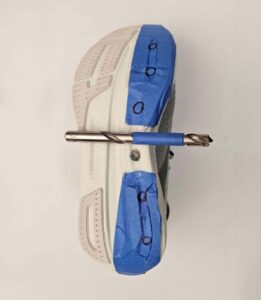
Traditional running shoes typically do not have sidewall midsole voids. Instead, access to the midsole is created from the plantar aspect of the shoe, through the outsole. In these cases, half-inch diameter holes are drilled from the bottom of the shoe to reach the midsole–along the medial border for pronators or the lateral border for supinators. These plantar access holes are drilled 1 inch deep in the heel and midfoot and half inch in the forefoot. You can add tape to the drill bit to make the depth.
Care must be taken when drilling through the outsole, as outsole rubber often does not drill cleanly. When possible, drilling should be performed in areas with minimal or no outsole coverage, such as split-sole designs where the midsole is exposed. Many performance shoes include such windows; for example, in split-sole models like Brooks Hyperion access can be gained through exposed midsole areas rather than forcing the drill through dense outsole rubber.
After access is created, hot-melt adhesive is injected into the midsole to create localized reinforcement. The hole is filled completely. When cooled, the hotmelt will form a slight recess. When hot melt cools there may be a slight depression which may require additional filling. If you prefer, you can insert a half-inch EV plug to fill the hole before the hot melt cools.
Biomechanically, this approach increases localized midsole stiffness, slows excessive pronation or supination, and preserves cushioning elsewhere in the shoe, effectively creating custom posting within the footwear itself.
Jeff Rich is a Board-Certified Pedorthist and the owner of the U.S. Orthotic Center in New York City, which specializes in orthotic manufacturing and shoe modification. For the past 46 years, he has employed a unique orthotic fabrication method that combines traditional craftsmanship with modern technology and serves professional athletes, including teams from the NBA and the US Olympic team. Additionally, he co-founded Masterfit Enterprises, which focuses on orthotic and footwear solutions, and has contributed significantly to the snowsports industry through training programs and product innovations. Rich holds 7 US patents, including 3 for orthotic designs. Jeff is the President of PFA and serves on several committees. He also heads the Pedorthic lab and teaches Pedorthics at Hamad Hospital in Qatar.
Click here for the article page