Why Healthy Feet Start with Flexible Calves
By a Board Certified Pedorthist
Section 1: How Tight Calves Affect Your Feet
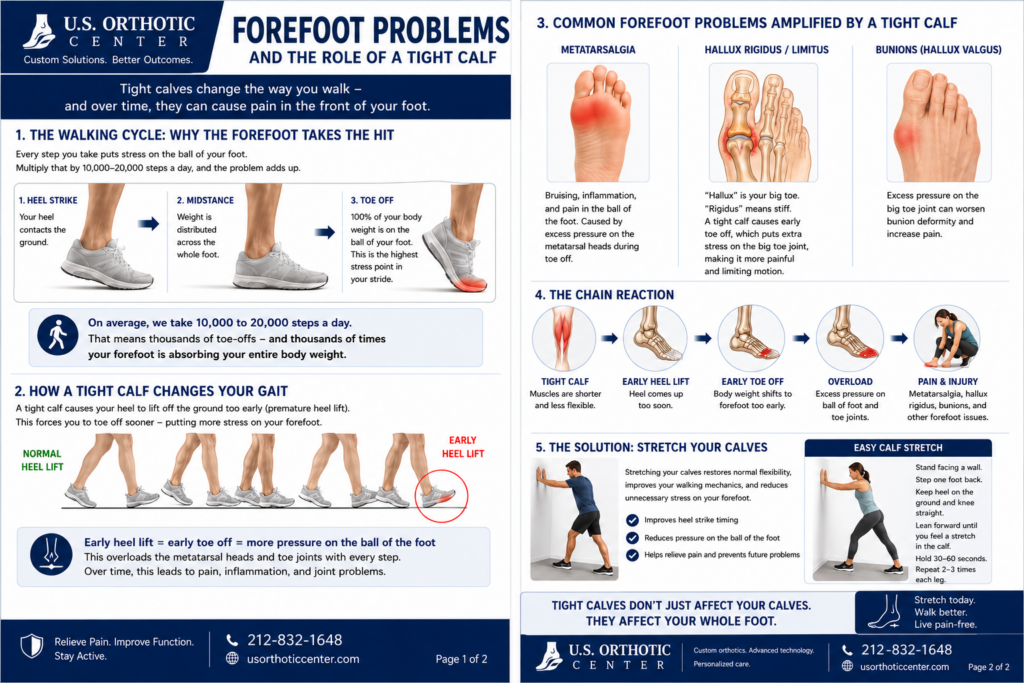
The Walking Cycle
Walking is a carefully coordinated movement consisting of three major phases:
Heel Strike
The heel contacts the ground first, beginning the walking cycle.
Midstance
Your body weight moves over the entire foot while the ankle gradually bends forward.
Toe-Off
As your heel lifts, your body weight transfers onto the ball of the foot before pushing off with the toes.
This final stage naturally places the highest amount of pressure on the forefoot.
What Happens When Your Calves Are Tight?
The calf muscles consist primarily of two muscles:
- Gastrocnemius
- Soleus
Both attach to the Achilles tendon and control ankle motion.
When these muscles lose flexibility, the ankle cannot move forward normally while walking. As a result, the heel lifts off the ground too early—a condition known as premature heel rise.
Instead of smoothly rolling through the foot, the body shifts weight onto the forefoot much sooner than it should.
This creates:
- Increased pressure beneath the metatarsal heads
- Greater stress on the big toe joint
- Overloading of the forefoot with every step
- Higher impact forces on the Achilles tendon
- Additional stress on the plantar fascia
Over months and years, these abnormal forces accumulate and often become chronic foot problems.
Common Conditions Associated with Tight Calves
Limited calf flexibility has been linked to many painful conditions including:
- Plantar Fasciitis
- Achilles Tendonitis
- Heel Pain
- Metatarsalgia
- Hallux Limitus
- Hallux Rigidus
- Bunions (Hallux Valgus)
- Forefoot Pain
- Recurrent Calf Tightness
- Increased Foot Fatigue
While tight calves are rarely the only contributing factor, they are frequently one of the largest mechanical causes.
Section 2: Why Calves Become Tight
Many people assume tight calves develop only from sports or exercise. In reality, modern lifestyles are often the biggest contributor.
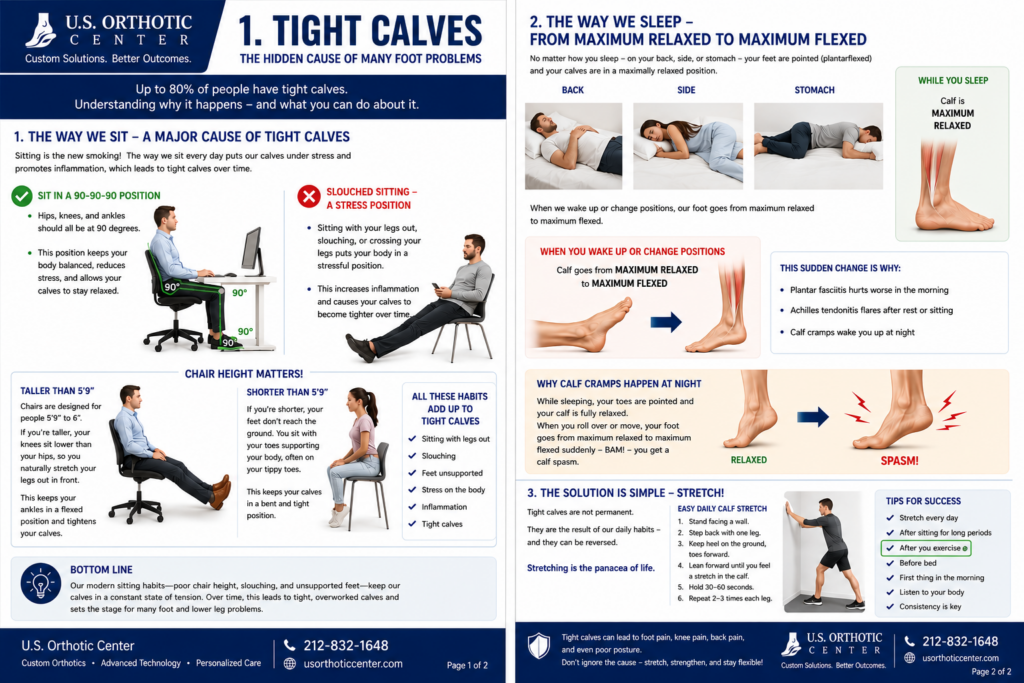
Prolonged Sitting
Long periods of sitting place the calf muscles in a shortened position.
Poor sitting posture can make this worse, especially when:
- Feet are unsupported
- Legs are stretched forward
- Knees remain extended for long periods
- The body slouches
Over time the muscles gradually adapt to this shortened position.
Maintaining approximately 90-degree angles at the hips, knees, and ankles while sitting helps reduce unnecessary calf tension.
Sleeping Position
During sleep the foot naturally relaxes into a downward pointed position known as plantarflexion.
This keeps the calf muscles shortened for several hours.
When you suddenly stand up in the morning, your ankle rapidly moves from its relaxed position into maximum dorsiflexion. This abrupt stretch explains why many people experience:
- Morning heel pain
- First-step pain
- Achilles stiffness
- Calf cramps
- Tightness after getting out of bed
The Chain Reaction
Reduced ankle flexibility starts a mechanical chain reaction:
Tight Calf Muscles
↓
Reduced Ankle Motion
↓
Early Heel Lift
↓
Early Toe-Off
↓
Excess Pressure on the Ball of the Foot
↓
Inflammation and Pain
↓
Chronic Foot Disorders
This process repeats with every step taken throughout the day.
Section 3: Stretching—One of the Simplest Ways to Improve Foot Health
Fortunately, calf tightness is often reversible through regular stretching.
Consistent stretching restores ankle flexibility, improves walking mechanics, reduces unnecessary stress on the foot, and helps improve the effectiveness of custom orthotics.
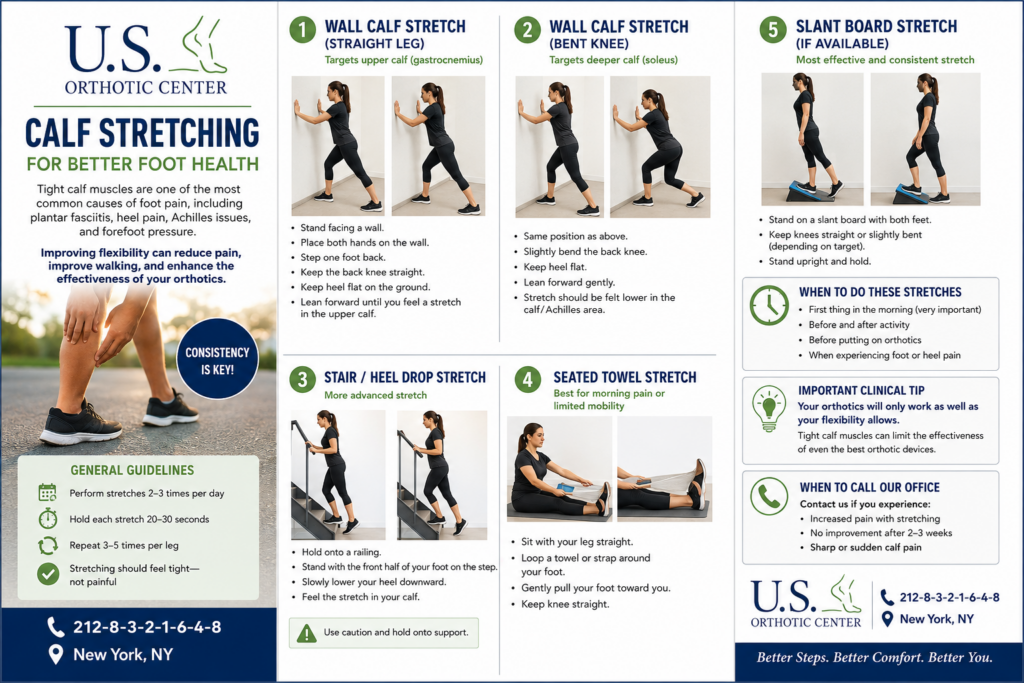
Recommended Calf Stretches
1. Wall Stretch (Straight Knee)
Targets the gastrocnemius, the larger superficial calf muscle.
- Stand facing a wall.
- Place one foot behind the other.
- Keep the back knee straight.
- Keep the heel flat.
- Lean forward until you feel a stretch in the upper calf.
2. Wall Stretch (Bent Knee)
Targets the soleus, the deeper calf muscle.
- Use the same position.
- Slightly bend the back knee.
- Keep the heel flat.
- Lean forward until the stretch is felt lower near the Achilles tendon.
3. Stair Heel Drop
A more advanced stretch.
- Stand on the edge of a step.
- Hold onto a railing.
- Slowly lower the heel below the level of the step.
- Hold the stretch without bouncing.
4. Seated Towel Stretch
Ideal for:
- Morning stiffness
- Limited mobility
- Older adults
- Plantar fasciitis sufferers
Loop a towel around the ball of your foot and gently pull the foot toward your body while keeping the knee straight.
5. Slant Board Stretch
When available, a slant board provides one of the most effective methods for maintaining a consistent calf stretch.
It allows both calf muscles to be stretched while maintaining proper foot positioning.
Stretching Guidelines
For best results:
- Stretch 2–3 times daily
- Hold each stretch 20–30 seconds
- Repeat 3–5 repetitions per leg
- Stretch should feel firm but never painful
- Breathe normally and avoid bouncing
- Consistency produces better long-term results than occasional aggressive stretching
Stretching is especially helpful:
- First thing in the morning
- Before exercise
- After exercise
- Before wearing custom orthotics
- During long workdays that involve standing or walking
Final Thoughts
Healthy feet begin with healthy movement.
Tight calf muscles can quietly alter the mechanics of walking long before pain develops. Over time, these changes increase stress on the heel, Achilles tendon, plantar fascia, forefoot, and toe joints, contributing to many of the most common foot disorders seen in clinical practice.
Regular stretching is one of the simplest and most effective ways to improve flexibility, restore normal gait mechanics, and reduce excessive pressure throughout the foot. When combined with properly fitted footwear, custom orthotics, and a comprehensive treatment plan from a qualified foot care professional, improving calf flexibility can play a significant role in preventing injury and maintaining lifelong foot health.